
From Digital Product Passports to Intelligent Product Certificates: Moving Beyond Compliance

As Digital Product Passports (DPPs) become a core requirement under upcoming EU regulations, many companies are focusing on how to achieve compliance.
However, Digital Product Passports also represent something much bigger.
When product data becomes structured and accessible, it can enable entirely new business models, deeper customer relationships and more intelligent supply chains.
This raises a critical question:
Are companies simply implementing Digital Product Passports to meet regulatory requirements, or are they using them to transform how their businesses operate?
What Is a Digital Product Passport?
A Digital Product Passport (DPP) is a structured digital record that contains information about a product’s lifecycle.
This typically includes:
material composition
manufacturing origin
environmental impact
repair instructions
recycling guidance
The primary purpose of a DPP is to improve transparency, traceability and compliance with sustainability regulations.
The Difference Between Compliance and Transformation
For many businesses, Digital Product Passports are introduced as a compliance requirement.
In this form, a DPP functions as a standardized dataset that ensures regulatory alignment.
While this is necessary, it often results in a passive data structure that:
stores information
fulfills legal requirements
has limited interaction with users
The real opportunity lies in how this data is used.
When integrated into business processes, product data can become a strategic asset rather than a compliance obligation.
From Passive Data to Intelligent Product Systems
Structured product data can support much more than compliance.
When companies connect Digital Product Passports with digital tools and systems, they can enable:
supply chain intelligence
predictive analytics
customer interaction
lifecycle optimization
This transition represents a shift from static product data to intelligent product systems.
What Are Intelligent Product Certificates?
An intelligent product certificate builds on the foundation of Digital Product Passports by adding additional layers of functionality.
These can include:
real-time data interaction
secure product authentication
digital ownership tracking
analytics and insights
In this model, the Digital Product Passport becomes the data layer, while the product certificate becomes the interface for business value.
How Lingon Extends the Value of Digital Product Passports
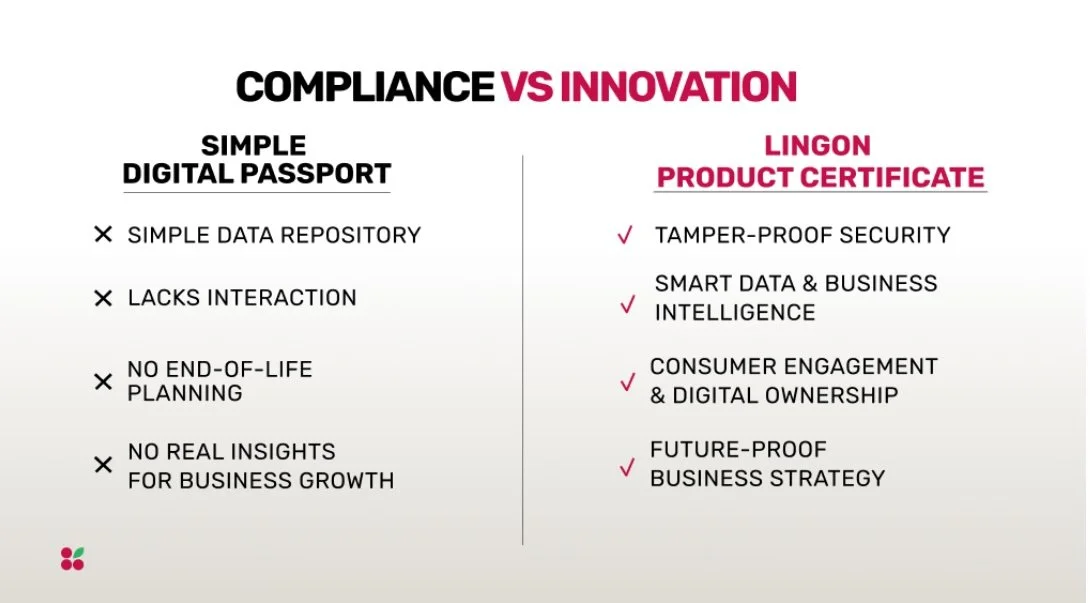
Lingon’s Product Certificate is designed to extend the functionality of Digital Product Passports beyond compliance.
Instead of acting as a static dataset, it transforms product data into an interactive and intelligent system.
Blockchain-Based Product Authentication
Lingon uses blockchain technology to create tamper-proof product records.
This ensures that product data remains secure and cannot be altered.
AI-Driven Product Insights
AI-powered analytics help companies optimize:
material selection
product design
lifecycle performance
Digital Ownership and Customer Interaction
Lingon Product Certificates enable customers to:
verify product authenticity
access product history
interact with manufacturers
This creates new opportunities for customer engagement and long-term relationships.
End-to-End Supply Chain Traceability
Lingon provides real-time visibility across the supply chain.
This enables companies to track materials, components and products throughout their lifecycle.
Automated Compliance and Data Management
Lingon simplifies compliance by automating:
data validation
reporting
audit processes
This reduces the operational burden of regulatory requirements.
The Strategic Choice: Compliance or Competitive Advantage
As Digital Product Passports become mandatory, companies face a strategic decision.
They can choose to:
implement the minimum required for compliance
oruse product data to transform their business
Companies that take a compliance-only approach will meet regulatory requirements but may miss broader opportunities.
Companies that go further can unlock:
stronger customer relationships
new revenue streams
more resilient supply chains
The Future of Product Transparency
Digital Product Passports represent the beginning of a broader transformation toward data-driven product ecosystems.
As technologies such as AI, blockchain and digital twins become more integrated, product data will evolve into a central driver of business innovation.
In this future, products are no longer static — they become connected, intelligent and continuously evolving assets.
Conclusion
Digital Product Passports are not just a regulatory requirement — they are a foundation for transformation.
While compliance is the first step, the real value lies in how companies use structured product data to create new capabilities and business models.
Companies that move beyond compliance and embrace intelligent product systems will be best positioned to lead in the next generation of circular and transparent industries.
Most Important Insights
Key takeaways from this article:
Digital Product Passports provide structured product lifecycle data required for transparency and compliance.
A compliance-only approach limits the potential value of product data.
Intelligent product certificates extend DPPs with analytics, authentication and interaction.
Structured product data can enable supply chain intelligence and new business models.
Platforms like Lingon transform Digital Product Passports into dynamic business tools.
Learn more about DPPs security features from the renown sources below:
Companies seek AI solutions to supply chain fragility, Financial Times, 2025
What Is A Digital Product Passport And How Does It Impact Businesses?, FineLine Technologies
Coach enables instant resale via Poshmark, Vogue Business, 2024