
How Digital Product Passports Work: From Product Data to Digital Identity
Imagine walking into a store, scanning a product label and instantly accessing detailed information about its origin, materials and environmental footprint.
This is the vision behind the Digital Product Passport (DPP) — an initiative driven by the European Union to improve transparency, traceability and sustainability across product supply chains.
But how are Digital Product Passports actually created and managed in practice?
What Is a Digital Product Passport?
A Digital Product Passport (DPP) is a structured digital record that contains information about a product’s lifecycle.
This information may include:
material composition
manufacturing origin
sustainability certifications
carbon footprint
repair instructions
recycling guidance
Digital Product Passports help businesses, regulators and consumers understand how products are produced, used and recycled.
The Digital Product Passport Process
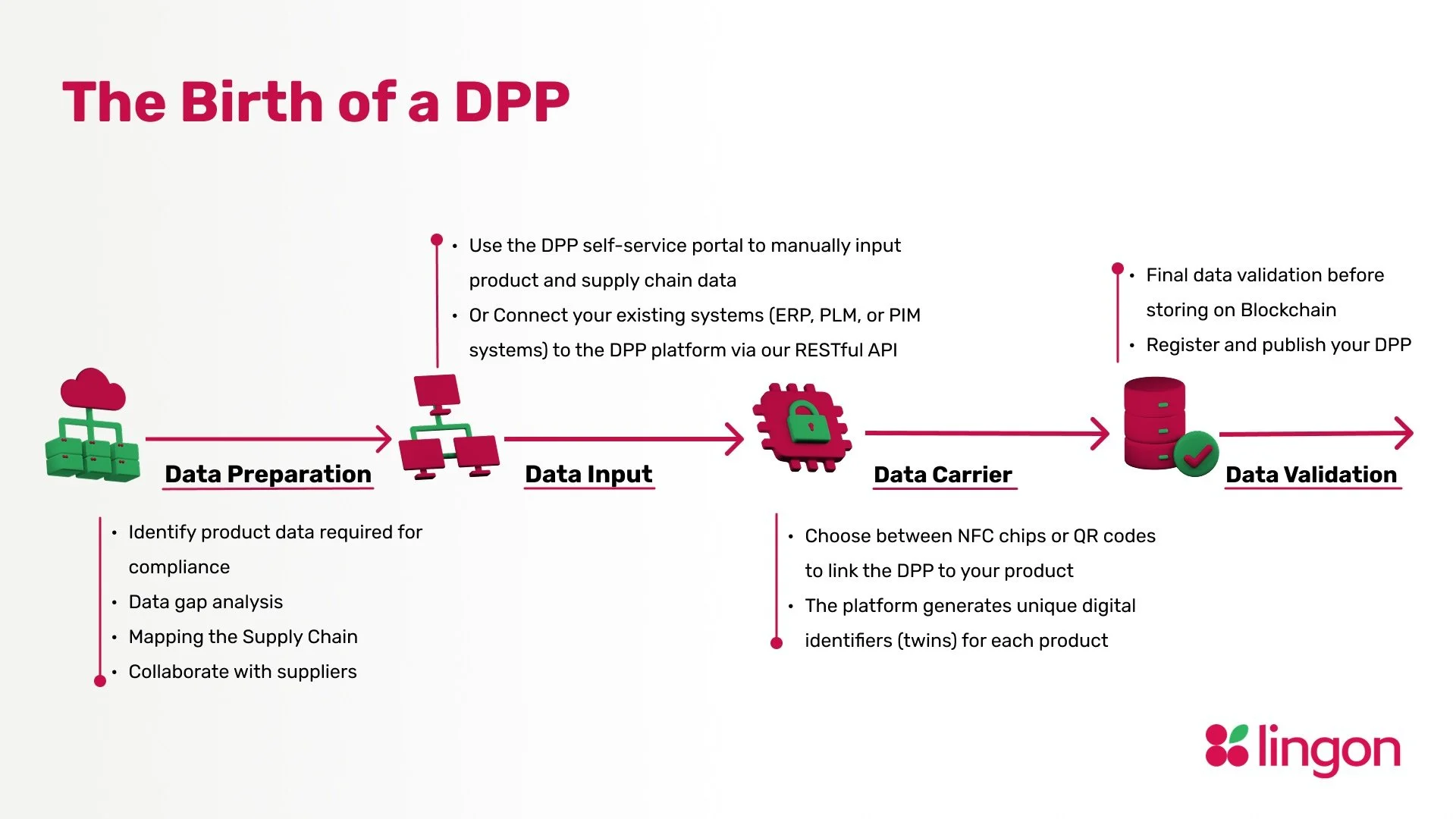
Although Digital Product Passports can initially seem complex, the implementation process becomes clearer when broken down into a series of structured steps.
Data Preparation
Every Digital Product Passport begins with collecting and organizing product data.
This can include:
sustainability certifications
material composition
carbon footprint data
repairability information
recycling instructions
As EU requirements continue to evolve, companies need to ensure that this data is structured, consistent and aligned with relevant standards.
Good data preparation creates the foundation for a reliable Digital Product Passport.
Data Input and Integration
Once the product data has been prepared, it must be entered into a digital system.
This can be done in different ways depending on a company’s technical maturity.
Smaller businesses may input data manually, while larger organizations often rely on API integrations that connect internal systems directly to a Digital Product Passport platform.
APIs enable:
real-time data updates
improved accuracy
reduced manual work
For industries such as furniture and lighting, where products often involve complex materials and global supply chains, automated integration is especially valuable.
Data Transmission Methods
After the data has been stored and structured, it must be made accessible.
Digital Product Passports can be delivered through technologies such as:
QR codes
NFC chips
embedded digital identifiers
The transmission method depends on the product’s design, material and intended use.
The goal is to ensure that the Digital Product Passport remains easy to access without compromising product design or usability.
Data Validation and Registration
Validation is one of the most important stages in the Digital Product Passport process.
At this stage, raw product data is transformed into verified and trustworthy information.
Technologies such as blockchain can help create tamper-proof records, ensuring that data cannot be changed after it has been registered.
In addition, automated checks can help ensure alignment with:
regulatory requirements
industry standards
internal data quality rules
As Digital Product Passports become more established in Europe, they are also expected to connect with centralized EU databases while remaining supported by decentralized storage systems.
This combination of validation, registration and storage creates a robust foundation for trusted product data.
The End-User Experience
Once a Digital Product Passport is live, it becomes a useful tool for both consumers and organizations.
Consumers can scan a product and instantly access information such as:
sustainability performance
recyclability
material origin
repair guidance
This transparency helps consumers make more informed decisions and increases trust in the product.
For companies and public organizations, Digital Product Passports also support:
sustainability reporting
audit preparation
supply chain visibility
regulatory alignment
How Lingon Supports Digital Product Passport Implementation
Managing Digital Product Passports can be complex, especially when companies are dealing with evolving regulations, multiple suppliers and fragmented product data.
Lingon helps simplify this process through an end-to-end platform that supports:
data preparation
system integration
validation workflows
Digital Product Passport generation
By automating key processes and supporting structured product data, Lingon helps companies prepare for Digital Product Passports in a way that is scalable and practical.
Beyond Compliance: The Business Value of DPPs
Although Digital Product Passports are often introduced through regulation, they also create clear business value.
Structured product data can help companies:
improve supply chain transparency
increase operational efficiency
strengthen customer trust
support circular business models
For furniture and lighting companies, this means Digital Product Passports can become more than a compliance requirement — they can become a foundation for innovation.
Conclusion
Digital Product Passports are reshaping how product data is created, validated and shared.
While implementing a DPP requires structured processes and strong data management, the journey becomes far more manageable when broken down into clear stages.
Companies that begin building their product data infrastructure now will be better prepared for future regulations — and better positioned to unlock the wider business value of transparency, traceability and circularity.
Most Important Insights
Key takeaways from this article:
Digital Product Passports rely on structured product lifecycle data.
The DPP process includes data preparation, integration, transmission and validation.
Technologies such as APIs, QR codes and blockchain help support DPP systems.
Digital Product Passports improve transparency for consumers, businesses and regulators.
Platforms like Lingon simplify DPP implementation and help companies prepare for future requirements.
Learn more about Digital Product Passports from the renown sources below:
The Future Of Manufacturing With Digital Product Passports, Forbes 2024
Embracing Digital Product Passport as a regulatory requirement, Deloitte 2024
A Digital Product Passport Needs More Standardization And Fewer Standards, Forrester 2024